Commercial Waste High Wycombe — Recycling & Sustainability Commitment
 In High Wycombe the approach to commercial waste is evolving: businesses and local services are building a practical, measurable pathway to a cleaner, *eco-friendly waste disposal area* and a resilient sustainable rubbish area. This page outlines how Commercial Waste High Wycombe providers, local authorities and community partners work together to raise recycling rates, reduce carbon emissions and improve reuse options for commercial operators across the town centre and surrounding industrial parks. Emphasis is on clear separation at source, practical on-site measures and measurable targets that help companies meet environmental responsibilities.
Local policy and practice for commercial waste in High Wycombe complement household recycling strategies by promoting separation of mixed recyclables, food waste, glass and paper at the business level. Many borough approaches favour easy-to-follow streams: segregated bins for dry recycling, labeled containers for organics, and dedicated collections for cardboard and bulky commercial items. Businesses are encouraged to adopt simple operational changes — like visible signage and staff training — that dramatically improve capture rates for recyclable materials.
 The transition to a local eco-friendly waste disposal area relies on partnerships across the public, private and voluntary sectors. Commercial Waste High Wycombe teams coordinate collections to feed local transfer stations and material recovery facilities, ensuring that commercial loads are processed efficiently and recycled where feasible. That collaborative model reduces landfill dependency and prioritises reuse and material recovery, aligning with circular-economy principles that benefit both businesses and the community.
Our performance goals are concrete. The commercial waste sector in High Wycombe has set a **recycling percentage target** of 65% of commercial waste diverted from landfill by 2030 — a figure informed by local capacity and regional targets. To reach this goal, we focus on:
- Source separation improvements at business premises;
- Expanded reuse pathways and charity partnerships for still-usable items;
- Optimised collections and increased access to local transfer stations and MRFs (Materials Recovery Facilities).
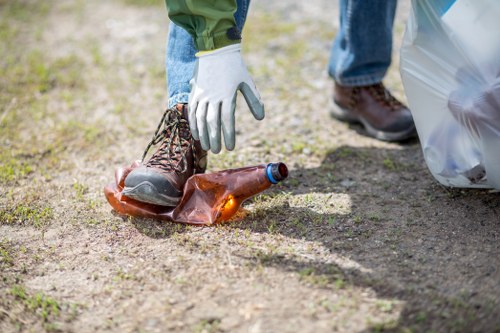 Local transfer stations act as the backbone for sorting and onward transport. Commercial Waste High Wycombe routinely utilises nearby Buckinghamshire transfer points and dedicated Wycombe facilities to streamline loads and minimise haul distances. This network reduces vehicle miles and opens routes to specialist recyclers handling glass, cardboard, metal, and food organics. By routing segregated commercial streams correctly at transfer stations, more material is reclaimed as secondary resources rather than being sent to disposal.
Charity partnerships are central to creating a meaningful sustainable rubbish area that extends the life of goods. Commercial waste teams in High Wycombe work with a range of non-profits and social enterprises to divert furniture, textiles and functional office equipment into reuse channels. These collaborations include coordinated collections for donation, refurbishment programmes and commercial-to-charity handover processes that recover value and support local social causes without compromising compliance or waste-management standards.
Fleet and logistics changes are among the most visible sustainability measures. A growing share of the High Wycombe commercial waste fleet uses **low-carbon vans** — hybrid and electric vehicles are deployed for short urban rounds — and larger trucks are being fitted with cleaner engine technology and emission reduction systems. Route planning software and consolidated collections cut empty miles and improve fuel efficiency, while standardised scheduling reduces disturbance in sensitive residential and business areas.
 Beyond vehicles, operational best practice includes staff training, regular bin audits and improved on-site storage to prevent contamination. Businesses are encouraged to adopt procurement policies favouring recycled-content packaging and services that accept take-back. These steps create a loop where less virgin material is needed and more waste becomes feedstock for manufacture — contributing to a local circular economy that benefits the High Wycombe business community and supports regional sustainability goals.

Measuring progress and future steps
Accountability, reporting and continuous improvement
Transparency is integral: progress toward the recycling percentage target is monitored through regular data collection at the point of collection and at transfer stations. Performance dashboards benchmark diversion rates, contamination levels and carbon savings achieved through fuel-switching and route reductions. Commercial Waste High Wycombe emphasises incremental improvement — with quarterly reviews, targeted interventions where contamination is high, and incentives for businesses that demonstrate measurable waste reduction.
Key initiatives include partner programmes with local charities for reuse, targeted investments in low-carbon vans, and business engagement campaigns to normalise source separation. The combination of on-site changes, strategic use of transfer stations and supportive partnerships creates an integrated model that helps businesses meet environmental commitments while keeping operational disruption to a minimum. For companies seeking to align with the borough’s waste separation approach and contribute to a thriving sustainable rubbish area, these measures form a practical, actionable roadmap.
In summary, High Wycombe commercial waste efforts focus on measurable outcomes: lifting diversion rates, strengthening reuse pathways through charity partners, expanding access to local transfer stations, and decarbonising collection fleets. By adopting these principles — clear separation, collaborative processing and low-emission logistics — the town’s commercial sector can create a resilient, efficient and genuinely eco-friendly waste disposal area that supports both the environment and local business vitality.
